
All-in-One ERP Software: Why One Connected Platform Beats Five Separate Tools
Tired of juggling separate tools? See how one connected ERP platform brings every department together.
All-in-One ERP Software: Why One Connected Platform Beats Five Separate Tools
Many growing businesses end up with a patchwork: one tool for accounting, another for inventory, a spreadsheet for production, a messaging group for orders and a separate file for payroll. Each tool made sense when it was added. Together, they create a business that runs on re-typing, reconciling and guessing.
All-in-one ERP software replaces that patchwork with a single platform where every department shares the same data. This article explains what that means in practice and how to judge whether it is right for your business.
The Hidden Cost of Disconnected Tools
Separate tools often look cheaper on paper. The real cost shows up elsewhere:
- Duplicate data entry: The same order or item is typed into two or three places.
- Errors and mismatches: Stock in the warehouse differs from stock in the books.
- Slow reporting: Management waits days to see consolidated numbers.
- Weak controls: Approvals happen on calls and chats with no clear record.
- Integration headaches: Linking tools together needs ongoing effort and often breaks.
- Training overhead: Staff must learn several interfaces and logic styles.
If some of this sounds familiar, our article on eight signs your business has outgrown spreadsheets may help you assess where you stand.
What "All-in-One" Should Mean
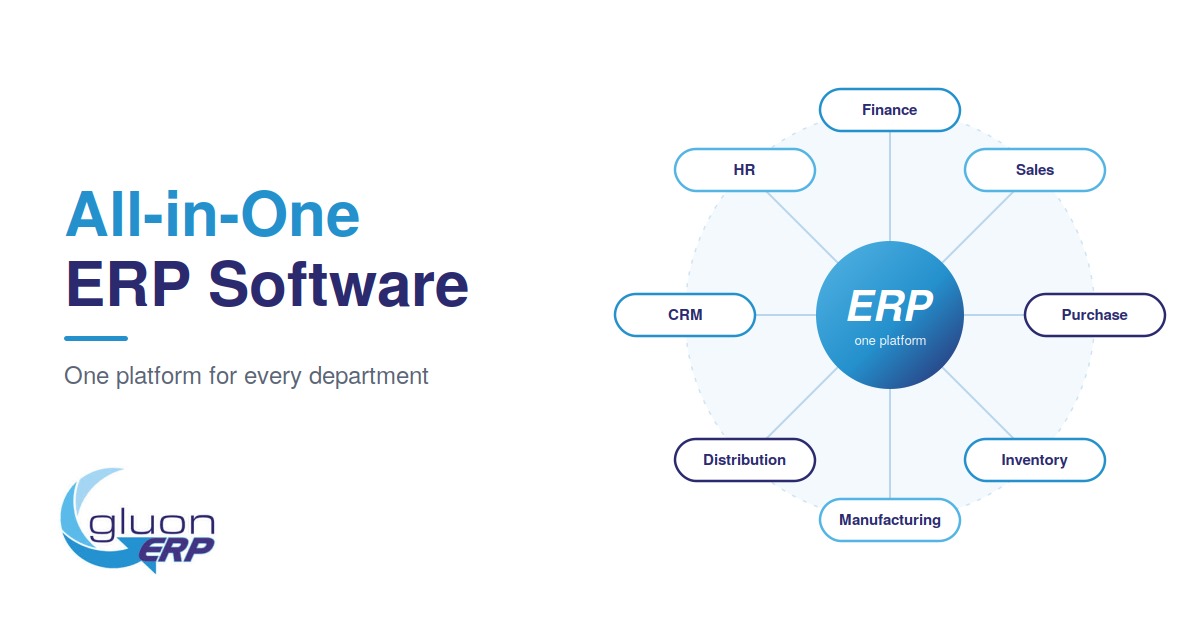
It does not mean a bloated system that does everything poorly. A good best ERP software choice for a growing company is a modular platform where each area works well alone and even better together:
- Finance: ledger, payables, receivables and reporting
- Sales: quotations, orders and invoicing
- Purchase: requisitions, orders and vendor management
- Inventory and warehouse: stock across locations
- Manufacturing: production planning and shop floor control
- CRM: customer records and follow-ups
- Human resources: employees and payroll
- Imports, quality and assets: specialized operational control
- Distribution: routes, distributors and secondary sales
How a Single Platform Changes Daily Work
Consider one sales order:
- The order is entered once.
- Stock is checked and reserved automatically.
- The warehouse sees the delivery task.
- The invoice is generated from the same data.
- The ledger and customer balance update without re-entry.
In a patchwork environment, each of those steps may involve a different tool and a person moving information between them.
The Benefits You Can Expect
- One source of truth for every department
- Real-time visibility for owners and managers
- Fewer errors because data is entered once
- Stronger controls through approvals and role-based access
- Faster month-end since records are already reconciled
- Easier scaling as new branches or products are added
When a Separate Tool Still Makes Sense
All-in-one is not always the answer for every function. Highly specialized needs may justify a dedicated tool. The key is to ensure it integrates cleanly with your core ERP so data still flows automatically.
How to Evaluate All-in-One ERP Software
- List your core processes and the departments involved.
- Check module depth, not just module count. Ask for demos of your real scenarios.
- Confirm local fit, including tax, invoicing and reporting needs.
- Look at usability. A system people avoid delivers no value.
- Ask about phased rollout so you can start with priority modules.
- Understand total cost, including implementation, training and support. See what an ERP really costs in Pakistan.
For a wider evaluation framework, read our guide to choosing the best ERP software in Pakistan.
How Gluon ERP Delivers One Connected Platform
Gluon ERP combines finance, sales, purchase, inventory and warehouse, manufacturing, CRM, human resources, imports, quality control, distribution and assets in a single system. Departments work from the same data, and management gets one consistent view of the business.
Ready to replace the patchwork? Book a free demo and see how it fits your business.
One platform.
Every part of your business.
Request Your Free
Gluon ERP Demo



and ERP insights delivered to your inbox.


